Our session at 2016 CAA Annual Conference was a success!

Earlier this month Thea Burns, Dawn Rogala, Allison Pappas and Birgit Cleppe presented their papers at the 2016 College Art Association Annual Conference in Washington. The session titled The Explicit Material: On the Intersections of Cultures of Curation and Conservation was chaired by Francesca Bewer and myself. The session invited an interdisciplinary dialogue between people already engaged in the museological discourse, and those willing to establish links between the fields of conservation and curation. Participants included conservation scholars, curators and academics. Our interest in conjoining curatorial expertise with conservation knowledge and the long tradition of combining hand and eye sensitivity to materials and technical processes derived from the conviction that insufficient attention has been paid to the benefits of interdisciplinary thinking about the materiality of objects. Conservation emerged as a field profoundly preoccupied with the nature of artworks. However, with the development of increasingly sophisticated tools of examination and analysis, the primacy of the object and the physical constitution appear to have gained ground in both academic und museological discourses. In fact, conservation has now become recognized as a field that has much to contribute to the humanities given the greater knowledge its findings afford us concerning how humans shape and use materials and objects. This link redirects to an article that discusses this topic more in depth.

We are planning to continue working on this topic and publish its results. Please follow us in Basel at the Third Basel Congress for Art Historians in June (Schweizerischer Kongress für Kunstgeschichte Basel, June 23-25, 2016), where I chair a thematically parallel session organized in cooperation with Katharina Ammann.

From left to right: Allison Pappas (The Museum of Fine Arts, Houston), Dawn Rogala (Museum Conservation Institute, Smithsonian Institution), Hanna Hölling (University College London), Francesca Bewer (Havard Art Musuems), Tha Burns (Independent Scholar Ontario), Birgit Clepe (Ghent University)


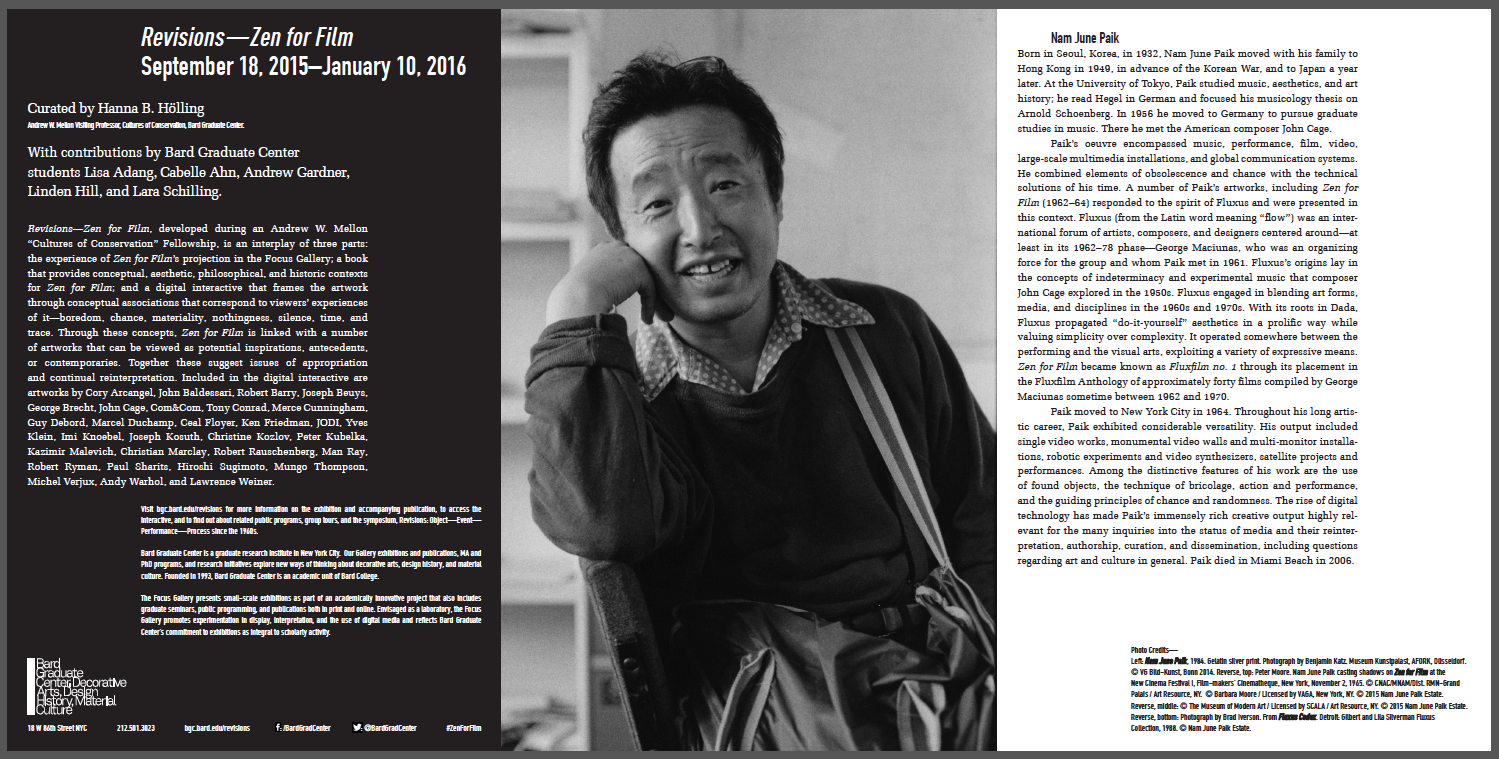
Video Revisions – Zen for Film

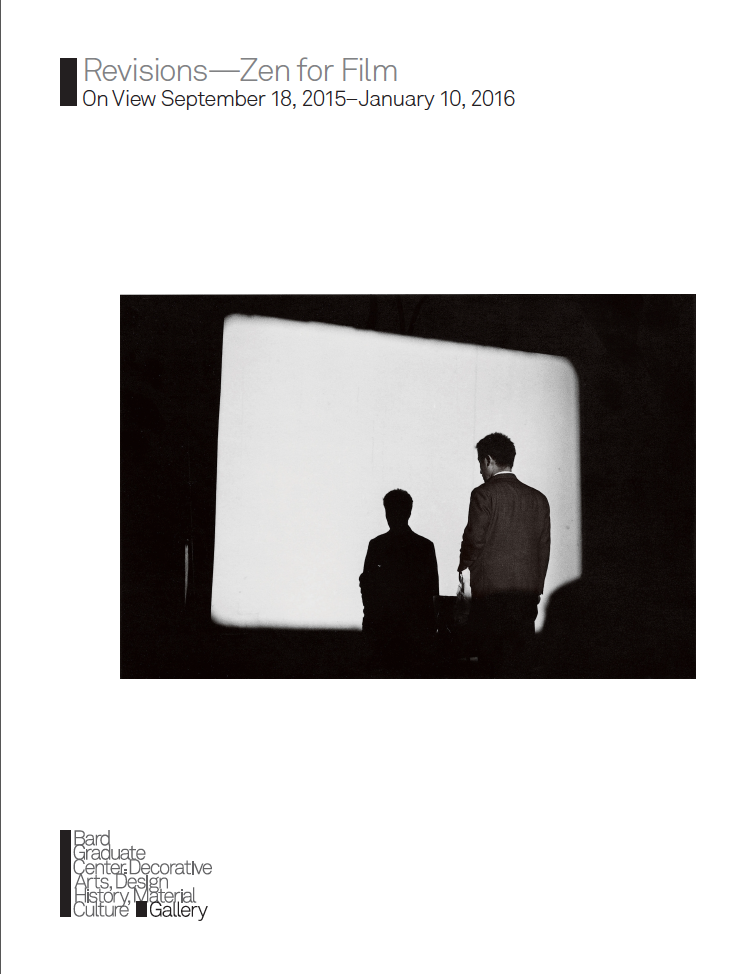
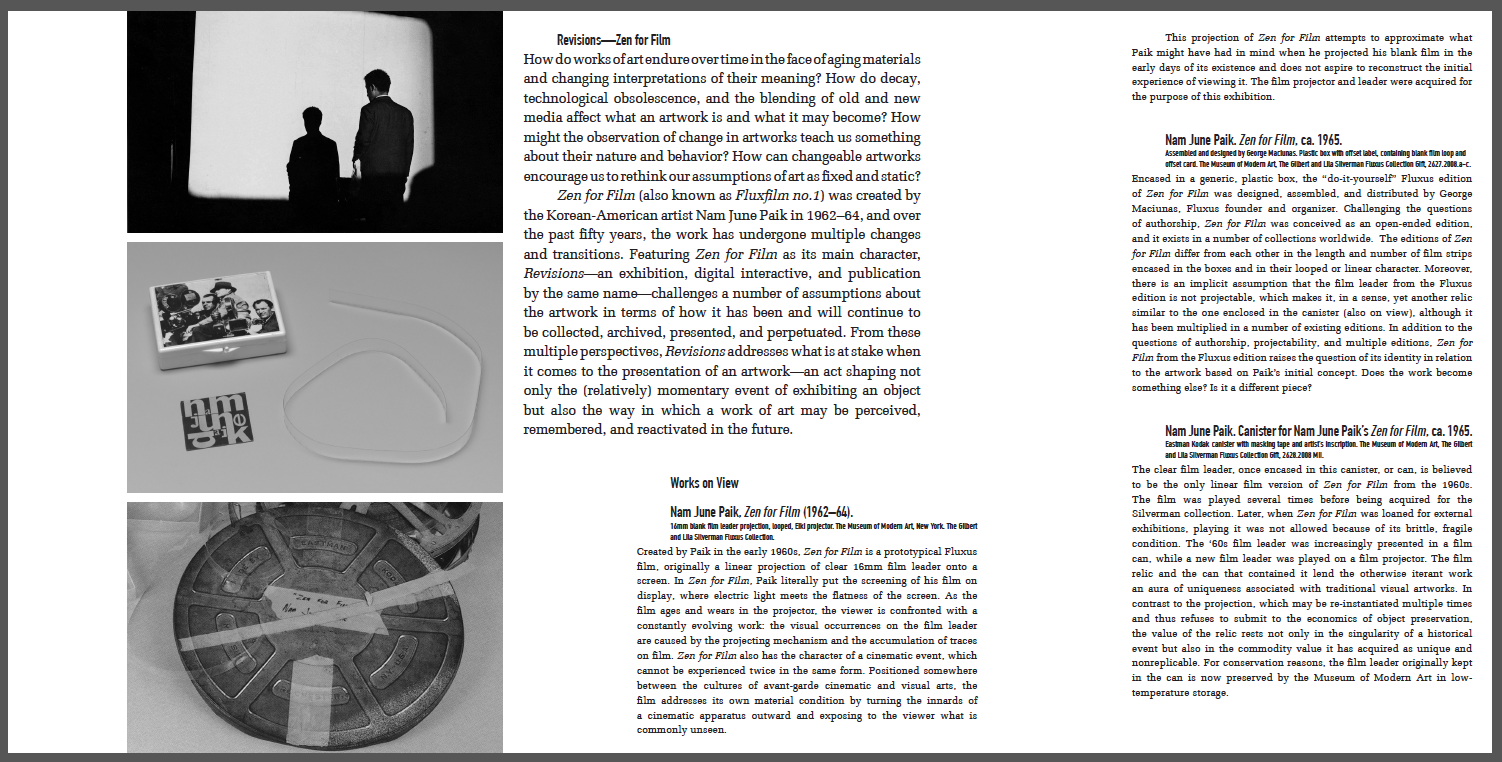
How do works of art endure over time in the face of aging materials and changing interpretations of their meaning? How do decay, technological obsolescence, and the blending of old and new media affect what an artwork is and can become? And how can changeable artworks encourage us to rethink our assumptions of a work of art as fixed and static? Revisions—Zen for Film, on view this fall and winter in the Bard Graduate Center Focus Gallery, explores these questions through Zen for Film, one of the most evocative artworks by the Korean-American artist Nam June Paik (1932–2006). Created during the early 1960s, Zen for Film consists of the screening of blank film leader for several minutes. As the film ages and wears in the projector, the viewer is confronted with a constantly evolving work. Revisions—Zen for Film provides a fresh perspective on an artwork with a rich history of display by asking precisely what, how, and when is Zen for Film?

On View September 18, 2015–February 21, 2016 at Bard Graduate Center Gallery
More: http://www.bgc.bard.edu/gallery/gallery-at-bgc/revisions.html
Digital Interactive: http://bgcdml.net/revisions/interactive.htm

Video narrated by curator Hanna B. Hölling, Andrew W. Mellon Visiting Professor, Cultures of Conservation, Bard Graduate Center

Media in Transition – Nam June Paik & Fluxus: Object, Archive, and Performance in Paik’s Multimedia

A major international conference at Tate Modern (18–20 November 2015) focused on the intersection of media art and technological change over time. How is this shifting the way museums operate and how conservation works?

Following the format of the highly successful Object in Transition conference in 2008 this event will explore – through papers, panel discussions, demonstrations and dialogues – how the field is adapting and responding to these new forms of artistic practice, and how emerging modes of collaboration between artists, conservators, art historians, technical experts and curators can help advance the field.

Session Nam June Paik & Fluxus: Object, Archive, and Performance in Paik’s Multimedia is now online, with presentations from Hanna Hölling (Andrew W. Mellon Visiting Professor, Bard Graduate Centre, New York and Max Planck Institute for the History of Knowledge, Berlin), Michael Mansfield (Curator of Film and Media Arts, Smithsonian American Art Museum), and Sook‐Kyung Lee (Research Curator, Tate Research Centre: Asia‐Pacific, Tate).

The Explicit Material: On the Intersections of Cultures of Curation and Conservation is online

The “explicit material” approach wishes to advance a way of thinking about the materiality of objects as they enter our collections and undergo a transformation from their previous context(s) to a museological one. This session invites an interdisciplinary dialogue to explore the relationships between curatorial and conservation philosophies across a range of institutions, focusing on the ways in which these apparently divergent fields shape thinking about—and the practices of—collecting, exhibiting, and caring for objects. The presentations cover a wide range of subject matter: from perishable media to medieval manuscripts, and from self-effacing photographs to films on museum collections, and myths about abstract expressionists. The conservators, scholars, curators and artist on the panel are in dialogue about questions of materiality, value, uniqueness, endurance and decay, and attempt to give a more nuanced voice to different forms of documentary evidence.

For more information about the conference, click here.

Screen Shot 2015-12-10 at 14.42.10


Symposium—Revisions: Object—Event—Performance since the 1960s

In the 1960s, the art world and its objects began to experience a dramatic shift in what and how art can be. New modes of artistic expression articulated through Fluxus activities, happening, performance, video, experimental film and the emerging practices of media art questioned the idea of a static object that endures unchanged and might thus be subject to a singular interpretation. Different from traditional visual arts, the blending genres and media in art since the 1960s began to transform not only curatorial and museum collecting practices, but also the traditional function and mandate of conservation, now augmented to accept the inherent dynamism and changeability of artworks.

Can Fluxus be musealized? How to conceive of the afterlives of performance? How to negotiate the continuity of experimental film in between the visual and cinematic cultures? How to locate new media beyond the paradigmatic singularity and uniqueness of traditional “objects”? Can the notion of conservation be sustained? Engaging in what might be called an expanded curatorial and conservation discourse, this symposium brings together international scholars in visual and performing arts, film, media, curatorial and conservation studies to debate aspects of continuity and change in artworks on the occasion of the Focus Gallery exhibition Revisions—Zen for Film.

Revisions—Zen for Film was developed during a two-year Andrew W. Mellon “Cultures of Conservation” Fellowship at Bard Graduate Center.

Streamed live on Sep 21, 2015 from Bard Graduate Center’s Lecture Hall, 38 West 86th Street, New York

11:15–11:25am
Introduction

11:25am–12:00pm
Hanna Hölling
2013-2015 Andrew W. Mellon Visiting Professor, Cultures of Conservation, Bard Graduate Center
Visiting Scholar, MPIWG, Berlin
“Zen for Film: Object, Event, Performance, Process”

12:00–1:30pm
Lunch

1:30–2:05pm
Glenn Wharton
Clinical Associate Professor, Museum Studies, New York University
“Between Objects and Performance: Translating Artworks at the Contemporary Art Museum”

2:05–2:40pm
Hannah Higgins
Professor, Chair of Art History, University of Illinois, Chicago
“Reperformance: A Typology”

2:40–3:15pm
Coffee break

3:15–3:50pm
Sarah Cook
Reader and Curator, University of Dundee
“Restart: A Curatorial Perspective on Generative and Variable Media Art Works”

3:50–4:25pm
Andrew V. Uroskie
Associate Professor, Director of Graduate Studies, MA/PhD Program in Modern Art History, Criticism & Theory, Stony Brook University
“Philosophical Toys: Marcel Duchamp, Robert Breer and the Problem of the Moving Image for Institutions of Postwar Art”

4:25–5:30pm
Panel discussion

5:30–6:00pm
Reception
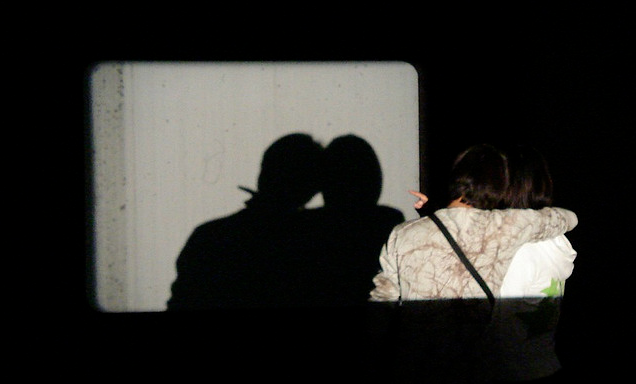
Reflections on “Revisions—Zen for Film” by Lara Schilling

On September 21, a group of international scholars presented papers at the Bard Graduate Center symposium, “Revisions: Object—Event—Performance since the 1960s,” following the opening of the Focus Gallery exhibition ‘Revisions—Zen for Film’. In a new blog post, Lara Schilling, a second-year M.A. student at Bard Graduate Center in New York City reflects on the day’s vital interdisciplinary dialogue regarding important contemporary issues in the ongoing conservation & curation of multimedia artworks.

Read more >>

The panel discussion. From left to right: Glenn Wharton, Hannah Higgins, Hanna Hölling, Sarah Cook, Andrew V. Uroskie.


A new blog post by Lara Schilling on the network of Voices in Contemporary ArtVoices in Contemporary Art

VoCA Logo


Baldessari, Beuys, Brecht, Cage, Cunningham, Duchamp, Warhol, and Weiner

.. among the excellent artistic positions represented in our digital interactive!

The full list of artists include: Cory Arcangel, John Baldessari, Robert Barry,Joseph Beuys, George Brecht, John Cage, Com&Com, Tony Conrad, Merce Cunningham, Guy Debord, Marcel Duchamp, Ceal Floyer, Ken Friedman, JODI, Yves Klein, Imi Knoebel, Joseph Kosuth, Christine Kozlov, Peter Kubelka, Kazimir Malevich, Christian Marclay, Robert Rauschenberg, Man Ray, Robert Ryman, Paul Sharits, Hiroshi Sugimoto, Mungo Thompson, Michel Verjux, Andy Warhol, and Lawrence Weiner

Visit Revisions-Zen for Film.